

Global Sustainability Weekly | Reporting window: September 25–October 2, 2026
1. India puts grids and storage at the center of its renewable strategy
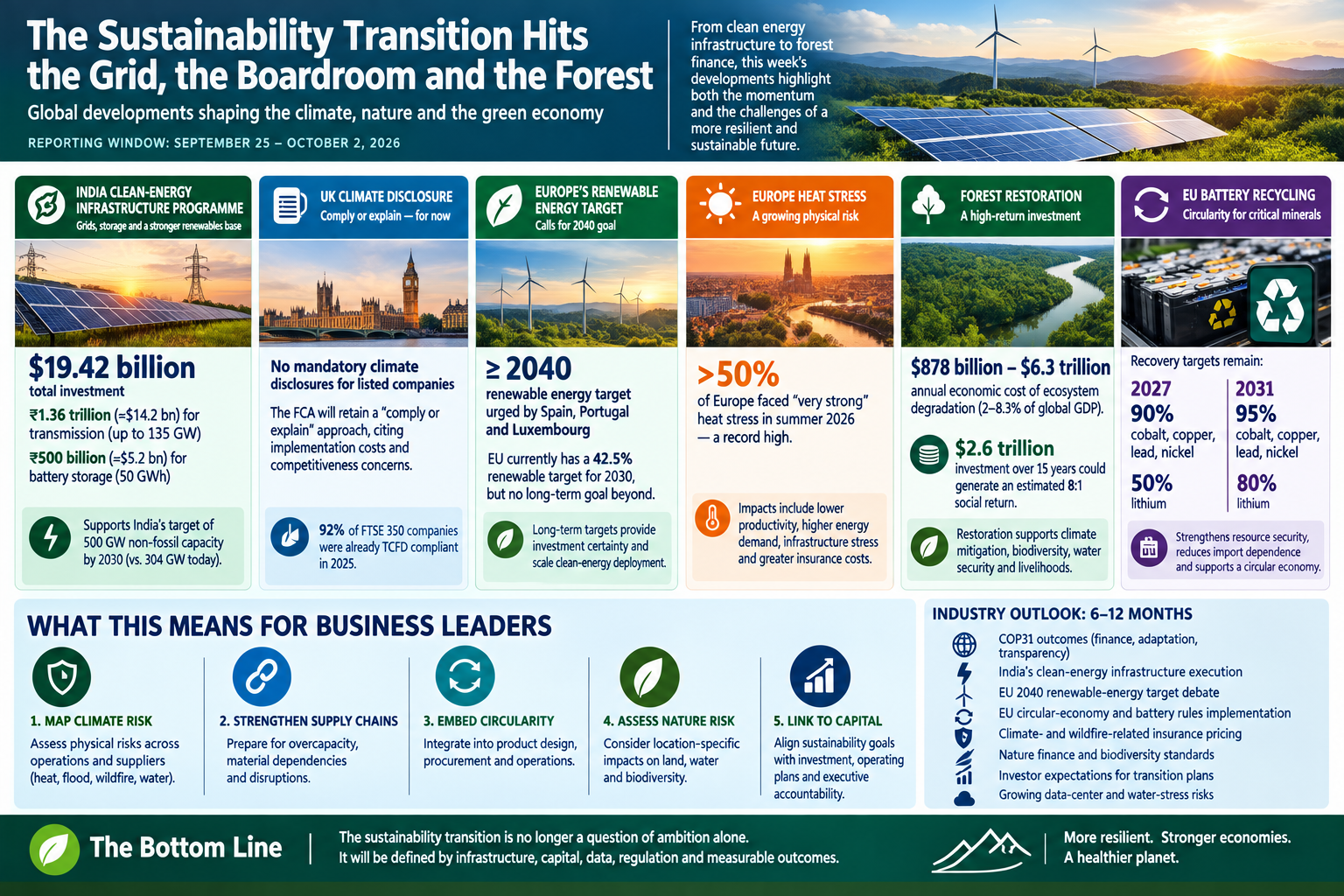
India approved a ₹1.86 trillion ($19.42 billion) renewable-energy infrastructure programme on September 30. Of this, approximately ₹1.36 trillion will strengthen intra-state transmission systems capable of evacuating up to 135 GW of clean power. A further ₹500 billion incentive programme will support deployment of 50 GWh of battery energy storage systems. Reuters
The initiative comes as India targets an increase in non-fossil power capacity from about 304 GW currently to 500 GW by 2030. Reuters
The significance extends beyond India. Renewable-energy economics are increasingly being determined by what happens after generation: transmission availability, storage, balancing, forecasting and demand management.
The development also demonstrates a broader shift in government priorities—from subsidizing generation alone toward financing the infrastructure required for reliable clean electricity.
Infographic placement: Use the India panel in the accompanying infographic immediately after this section.
2. UK climate reporting takes a less prescriptive route
The UK’s Financial Conduct Authority decided not to make climate-related disclosures mandatory for listed companies, retaining a “comply or explain” framework instead. The FCA cited implementation costs and concerns about international competitiveness. Reuters
The decision illustrates a growing regulatory divergence.
The UK remains aligned with international sustainability-reporting concepts, including the ISSB framework, but companies will retain more flexibility over whether and how they comply. The FCA noted that 92% of FTSE 350 companies were already compliant with TCFD requirements in its 2025 review, suggesting that market practice may continue to exceed the minimum legal requirement. Reuters
For multinational companies, the result is a more complex reporting landscape: regulatory requirements may vary even when investors increasingly expect comparable information.
The strategic implication is that companies should avoid designing climate reporting systems around minimum compliance alone.
3. Europe debates its next renewable-energy target
Spain, Portugal and Luxembourg have called for the European Union to establish a 2040 renewable-energy target. The EU currently has a 2030 objective of at least 42.5% renewable energy, but no equivalent long-term target beyond that date. Reuters
The debate reflects a fundamental investment issue. Long-term targets can provide utilities, manufacturers and infrastructure investors with greater visibility over future demand.
However, EU countries differ over whether the bloc should pursue a renewable-specific target or a broader “clean energy” target that also includes nuclear power. Reuters
For investors, the distinction matters because technology-neutral and technology-specific policies create different investment signals for grids, nuclear, solar, wind, storage and other technologies.
4. Extreme heat becomes an economic risk
More than half of Europe experienced “very strong” heat stress during summer 2026, according to the EU’s Copernicus Climate Change Service. The finding represents a record-high share of the continent affected by such severe heat conditions. Reuters
This is increasingly relevant to business strategy.
Heat affects worker productivity, electricity demand, infrastructure performance, agriculture, water availability and health. It can also raise insurance and business-continuity costs.
For corporate sustainability teams, adaptation is therefore moving closer to mainstream enterprise-risk management.
The key question is no longer simply how much a company emits, but how its operations perform under increasingly extreme conditions.
5. Forest restoration emerges as an economic investment
A new 2026 UN-linked assessment of global forests and landscape restoration estimates that failure to restore degraded ecosystems costs between $878 billion and $6.3 trillion annually, equivalent to roughly 2–8.3% of global GDP, depending on the valuation methodology. SDG Knowledge Hub
The assessment also estimates that investing approximately $2.6 trillion over 15 years in land-degradation and drought mitigation could produce an estimated eight-to-one social return. Restoration investments can potentially generate substantially higher returns in some circumstances. SDG Knowledge Hub
The significance is profound for sustainable finance.
Nature restoration is increasingly being framed not as a cost to the economy but as investment in productive assets—water security, food systems, carbon storage, resilience and rural livelihoods.
However, the financialization of nature must still address additionality, measurement, land rights and benefit-sharing.
6. Circular economy policy moves deeper into critical materials
The EU continues to use regulation to increase recovery of strategic materials from waste.
Under the EU Batteries Regulation, by 2027 recycling must achieve recovery of 90% of cobalt, copper, lead and nickel and 50% of lithium. By 2031 the targets rise to 95% and 80%, respectively. Environment
The European Commission says the targets are intended to strengthen resource security while supporting investment in recycling infrastructure. Environment
This reflects a broader evolution in circular-economy policy. Recycling is increasingly linked to industrial competitiveness, critical-mineral security and supply-chain resilience, rather than being treated solely as waste management.
Analysis: Four Trends Emerging
Infrastructure is becoming the bottleneck
India’s programme demonstrates that renewable generation alone cannot deliver energy security. Grids and storage are becoming strategic assets.
Regulatory divergence is increasing
The UK’s approach contrasts with jurisdictions pursuing more prescriptive sustainability requirements. Multinational companies will need flexible reporting architectures capable of serving different regimes.
Physical climate risk is moving into financial planning
Heat, wildfire, floods and water stress increasingly influence operational continuity, insurance and asset valuations.
Nature is becoming an economic issue
Forest restoration and biodiversity finance are moving closer to mainstream investment discussions as evidence of their economic value improves.
What This Means for Business Leaders
Five priorities stand out:
- Map physical climate risk across facilities and critical suppliers.
- Assess grid and energy-storage exposure, particularly for electricity-intensive operations.
- Build reporting systems around global standards, not minimum local requirements.
- Integrate circularity into procurement and product design, especially where critical materials are involved.
- Treat nature as a business dependency, examining exposure to forests, water, land and ecosystem services.
The strongest sustainability strategies will increasingly connect environmental objectives with financial resilience and operational performance.
Industry Outlook: The Next 6–12 Months
Organizations should monitor:
- India’s execution of the $19.42 billion clean-energy infrastructure programme.
- The EU debate over a 2040 renewable-energy target.
- Divergence in corporate climate-disclosure rules.
- Extreme heat and other physical climate risks.
- Implementation of EU circular-economy and battery requirements.
- Scaling of forest and biodiversity finance.
- COP31 discussions around adaptation, climate finance and transparency.
- The integration of nature-related risk into corporate and financial reporting.
The COP31 process is also placing increasing emphasis on access to climate finance, particularly for small island developing states and least-developed countries. UNFCCC
Conclusion: The Sustainability Test Is Changing
The most important sustainability story this week was not a single new target. It was the growing realization that targets depend on systems.
India is building transmission and storage. Europe is debating long-term renewable investment signals and strengthening circularity. The UK is recalibrating mandatory climate reporting. Extreme heat is demonstrating the economic consequences of physical climate risk. And forest-restoration research is putting a monetary value on ecosystem degradation.
The sustainability transition is therefore entering an execution phase.
For corporate leaders, the strategic question is increasingly:
Can the organization convert sustainability ambition into resilient infrastructure, credible data, financially viable investments and measurable outcomes?
That is likely to become the defining test of corporate sustainability over the next decade.
References
- Reuters, “India approves $19 billion for renewable energy programme,” September 30, 2026. Reuters
- Reuters, “UK regulator abandons mandatory climate disclosures for listed companies,” September 30, 2026.Reuters
- Reuters, “Spain, Portugal and Luxembourg push for 2040 EU renewable energy target,” September 29, 2026.Reuters
- Reuters, “Half of Europe faced very strong heat stress this summer, EU scientists say,” October 2, 2026.Reuters
- IISD SDG Knowledge Hub, “Forest, Landscape Restoration Key to Meeting Global Goals: SOFO 2026,” September 30, 2026. SDG Knowledge Hub
- European Commission, “Waste Batteries: Commission finds recycling targets remain fit for purpose,” September 11, 2026. Environment
- UNFCCC, COP31 observer forum on access to climate finance, September 30, 2026.
Discover more from Sustrainegrenity
Subscribe to get the latest posts sent to your email.
