

September 11–18, 2026
Major Global Sustainability Stories
Climate Policy: Physical Risk Moves to the Foreground
Indonesia’s wildfire season provided a stark reminder that climate policy extends beyond energy.
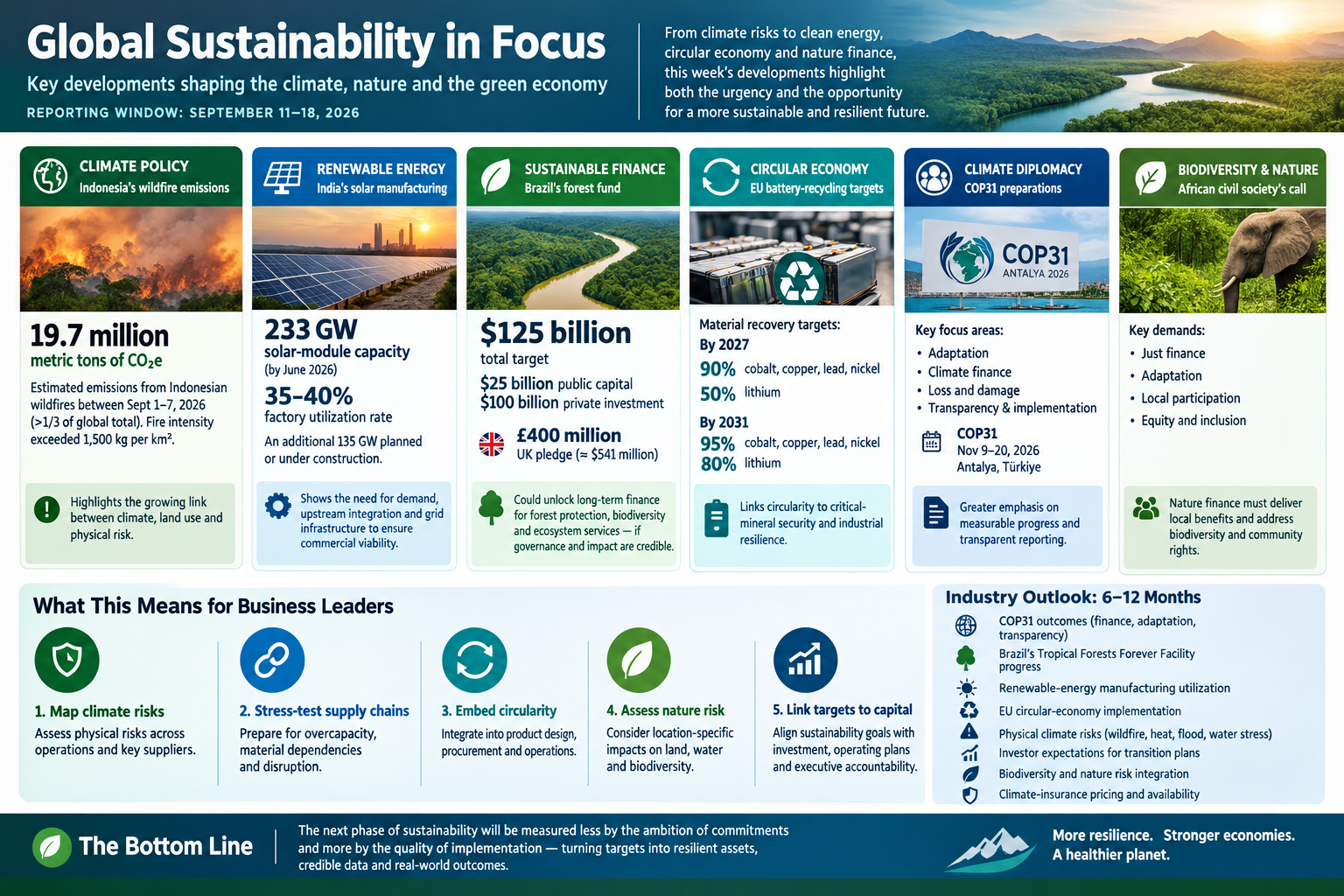
Copernicus Atmosphere Monitoring Service data showed that Indonesian fires released approximately 19.7 million metric tons of CO₂ equivalent between September 1 and 7, representing more than one-third of global fire emissions during that period. Fire intensity reportedly exceeded 1,500 kilograms per square kilometre, with significant activity across forest and peatland areas.
The consequences extend beyond emissions. Wildfires can generate severe air pollution, damage biodiversity and disrupt communities, transport and supply chains.
For companies exposed to agriculture, palm oil, pulp and paper, logistics and manufacturing in Southeast Asia, this creates a growing physical and supply-chain risk. It also demonstrates why corporate climate strategies increasingly need to incorporate land-use and ecosystem risks rather than focus exclusively on energy emissions.
Sustainable Finance: Can Nature Become Investable?
Brazil’s Tropical Forests Forever Facility is one of the most significant experiments in nature finance. The proposed facility aims to mobilize approximately $125 billion, including $25 billion in public capital and around $100 billion from private investors.
The United Kingdom has pledged a £400 million, approximately $541 million, loan.
The model seeks to reward countries for maintaining standing forests rather than relying solely on conventional carbon markets.
Its significance extends beyond Brazil. If successful, similar approaches could provide financing for biodiversity, watershed protection and other ecosystem services.
But substantial questions remain. Investors require predictable returns and transparent impact measurement, while governments and Indigenous and local communities require credible governance and benefit-sharing mechanisms.
Nature finance is therefore moving from an environmental concept toward a financial-market proposition—but its scalability will depend on institutional credibility.
Renewable Energy: Scale Does Not Guarantee Competitiveness
India’s solar industry illustrates another transition challenge.
Solar-module manufacturing capacity reached approximately 233 GW by June 2026, while factory utilization was estimated at only 35–40%. An additional 135 GW of capacity was reportedly planned or under construction.
The figures demonstrate the extraordinary pace of India’s industrial expansion, but also reveal a potential mismatch between manufacturing capacity and commercially viable demand.
The issue is broader than India. Governments across the United States, Europe and Asia are using industrial policy to accelerate clean-energy manufacturing. If several jurisdictions simultaneously build capacity, some technologies could experience overcapacity and falling margins.
The next stage of clean-energy policy therefore needs to focus not simply on manufacturing capacity, but on demand, exports, grid infrastructure, upstream supply chains and financial sustainability.
Corporate ESG: Targets Face Greater Scrutiny
Corporate climate commitments are increasingly being evaluated through their implementation pathways.
Investors are asking whether companies can connect emissions targets to procurement, capital expenditure, supplier engagement, product design and executive accountability.
This represents an important evolution in ESG. A target without a credible implementation mechanism increasingly carries less informational value.
For corporate sustainability leaders, the implication is significant: sustainability reporting needs to connect more closely with financial planning and operational decision-making.
The question is shifting from:
“What is your target?”
to:
“What changes in the business will produce the target?”
Circular Economy: Batteries Become a Strategic Resource Issue
The European Commission confirmed that existing EU battery-recycling targets remain appropriate. By 2027, recovery targets include 90% for cobalt, copper, lead and nickel and 50% for lithium. By 2031, these rise to 95% and 80%, respectively.
The policy links circularity directly to critical-mineral security.
For battery manufacturers, automakers and recyclers, this means greater attention to collection systems, material recovery, product traceability and recycling infrastructure.
The wider lesson is that circular economy policy is evolving from waste management toward industrial resilience and strategic resource security.
Biodiversity and Nature: Finance Meets Governance
Nature remains one of the most difficult areas of sustainability to translate into corporate strategy because biodiversity impacts are highly location-specific.
Forest finance initiatives such as Brazil’s facility demonstrate the potential for financial markets to support conservation, while African civil-society organizations are emphasizing equitable finance, adaptation and local participation ahead of forthcoming climate negotiations.
For companies, this means nature strategies increasingly need to consider where impacts occur, who controls the relevant resources and how benefits are distributed.
Generic biodiversity commitments will be less useful than location-specific assessments of land, water, ecosystems and community relationships.
Analysis: What the Week Reveals
Emerging Trends
Three trends are particularly visible.
First, sustainability is becoming infrastructure policy. Renewable energy requires grids, storage and transmission; circularity requires collection and recycling infrastructure; adaptation requires resilient physical assets.
Second, nature is entering mainstream finance. But investors will demand stronger governance and impact verification.
Third, ESG is becoming more evidence-driven. Targets and narratives increasingly need operational data behind them.
Economic Implications
The transition creates opportunities in renewable energy, storage, recycling, adaptation, traceability and nature finance. At the same time, rapid investment can produce overcapacity, particularly where industrial policy encourages simultaneous manufacturing expansion.
Companies therefore need to distinguish between growth in capacity and growth in economically viable capacity.
Regulatory Implications
Regulation is becoming more specific, measurable and supply-chain oriented. Battery recovery, deforestation, circularity and climate disclosure rules increasingly require companies to produce auditable information.
Multinational businesses will face a continuing challenge of regulatory fragmentation between Europe, North America, Asia and emerging markets.
Investment Implications
Capital is likely to increasingly favor projects combining measurable environmental outcomes with credible economics.
Grid infrastructure, storage, recycling and climate adaptation could benefit from this trend. Nature finance may also expand, but governance, measurement and community-rights questions will remain important investment considerations.
What This Means for Business Leaders
Business leaders should prioritize five actions:
- Map physical climate risks across facilities and critical suppliers.
- Stress-test clean-technology supply chains for overcapacity and material dependencies.
- Integrate circularity into product and procurement decisions.
- Assess nature risk geographically, particularly land, water and biodiversity exposure.
- Link sustainability targets to capital allocation and operating plans.
The sustainability function is becoming more valuable when it influences decisions before capital is committed rather than simply documenting them afterward.
Industry Outlook: The Next 6–12 Months
Organizations should closely monitor:
- COP31 outcomes on climate finance, adaptation, transparency and implementation.
- The development of Brazil’s Tropical Forests Forever Facility.
- Renewable-energy manufacturing utilization and supply-chain consolidation.
- EU implementation of battery and broader circular-economy requirements.
- Physical climate risks, including wildfire, heat, flood and water stress.
- Investor expectations for credible corporate transition plans.
- Increasing integration of biodiversity and nature risk into corporate strategy.
- Climate-insurance pricing and availability in high-risk regions.
Conclusion: Delivery Is the New Sustainability Test
The week’s developments point toward a sustainability transition increasingly defined by execution.
Indonesia’s wildfires demonstrate the immediacy of physical climate risk. India’s solar industry illustrates the challenges of scaling clean technology economically. Europe’s battery rules show circularity becoming part of industrial strategy. Brazil’s forest-finance initiative demonstrates both the potential and complexity of nature finance.
For companies and investors, the implication is straightforward:
The next phase of sustainability will be measured less by the ambition of commitments and more by the quality of implementation.
Organizations that can connect sustainability targets to capital, infrastructure, supply chains, data and measurable outcomes will be better positioned to navigate a transition increasingly shaped by both regulatory requirements and physical climate realities.
References
- Copernicus Atmosphere Monitoring Service, wildfire emissions data, September 2026.
- Institute for Energy Economics and Financial Analysis, India solar manufacturing analysis, September 2026.
- Reuters, reporting on Brazil’s Tropical Forests Forever Facility, September 2026.
- European Commission, battery-recycling targets, September 11, 2026.
- UNFCCC, COP31 and climate-transparency materials, 2026.
- WWF Africa, African civil-society priorities ahead of COP negotiations, September 2026.
Discover more from Sustrainegrenity
Subscribe to get the latest posts sent to your email.
